
Let your AI agent test the real board
Claude or Codex powers and flashes your board, drives its inputs and buses, and measures what it does.
Free sample board. Every request is reviewed case by case.
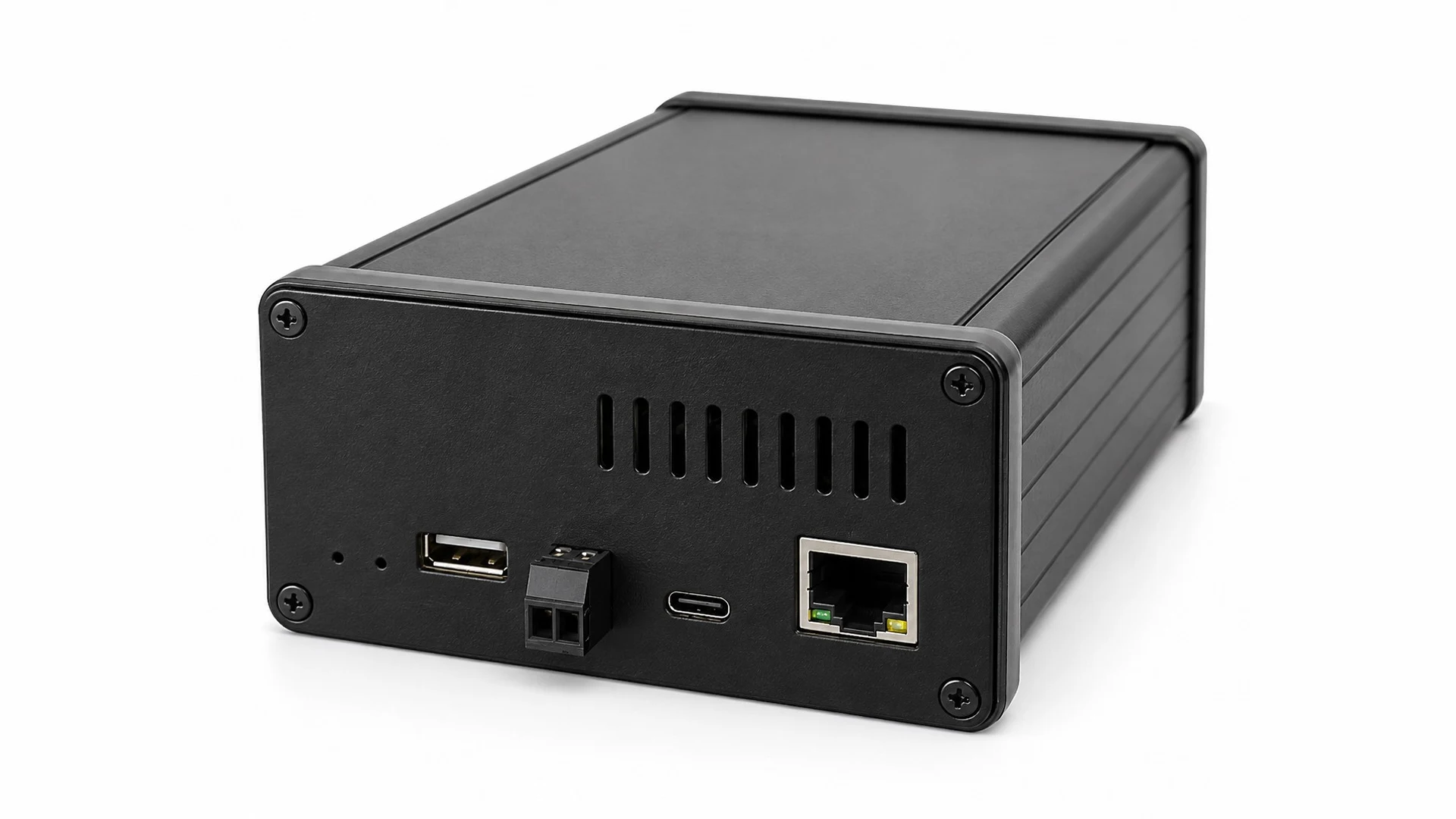
BenchPod in its enclosure: the digital core alone, or with the analog module on top.
What the pod sends and measures
The BenchPod powers your board, flashes it, drives its inputs and buses, and measures what comes out. One networked box.
Sends into the board
Power. Switch, cycle and cut the target: internal 5 V or your own supply.
Firmware. Flash over SWD and pull reset.
Analog signals. Voltages and waveforms, up to ±12 V. Replay a recorded signal.
4-20 mA. Drive a current loop like a field transmitter.
Sensors. Play any I2C, SPI, UART or analog sensor you describe in YAML, or one from the library. Change readings and inject faults while it runs: no answer, a stuck bus, bad data.
Buses. I2C and SPI master: read and write a chip’s registers, scan the bus. GPIO levels and timed pulses, strap pins, UART input, CAN and CAN FD frames and replies.
Measures what comes out
Current. Per rail and for the whole pod, over a whole run.
Logic. 14 channels, I2C, SPI and UART decoded.
Analog. 16-bit capture, up to ±30 V.
Console and CAN. Boot logs, 4-20 mA input, CAN traffic.
What teams test with it
Peripheral bring-up. Read and check a chip’s registers over I2C and SPI.
OTA and bootloader. Cut power or pull reset mid-update, then check it rolls back.
Bus faults. A stuck I2C bus or a sensor that stops answering. Does the firmware recover?
Boot and strap pins. Hold a boot pin through reset and check which mode the board starts in.
Timing regressions. Measure stimulus to response on every commit and catch the slow one.
Mixed-signal tests. Bus traffic, an analog input and a capture, in one test.
Tell the pod which pins your board drives and it refuses to drive against them.
Analog and 4-20 mA come with the analog module. Everything runs through one API: Python, CLI, MCP or the desktop app. Meet the BenchPod
You ask, it runs it on hardware
“Flash build/app.elf, power-cycle the board and show me the boot log.”
Flashed over SWD and power-cycled. The boot hangs before the sensor init.
“Pretend to be a BMP280 on the I2C lines and try again.”
Pull-ups on, BMP280 emulated, power-cycled. The board now boots and reports the sensor.
“Stop the emulation and scan the I2C bus yourself.”
Emulation stopped, I2C master on LA1 and LA2 at 400 kHz. Nothing answers: the sensor is not fitted on this board.
How it works
01
Wire your board to the pod
Power, SWD, UART and the signals you want to drive and watch.
02
Connect your agent
Claude, Codex or Cursor over MCP, the AI HIL tab in the web app, or BenchPod Desktop (free, no account).
03
Ask for the test
The agent flashes, powers, drives and measures the real board.
Found something worth keeping? The same calls are in the pytest SDK, so it becomes a test in CI. Tools: MCP docs.
Questions
Put an agent on your bench
Try it on your own board with a free sample, or book a call and we set it up with you.
Free sample board. Every request is reviewed case by case.